


Key Takeaways
- Choose equipment that is compact both during use and in storage, with enough surrounding clearance for safe movement.
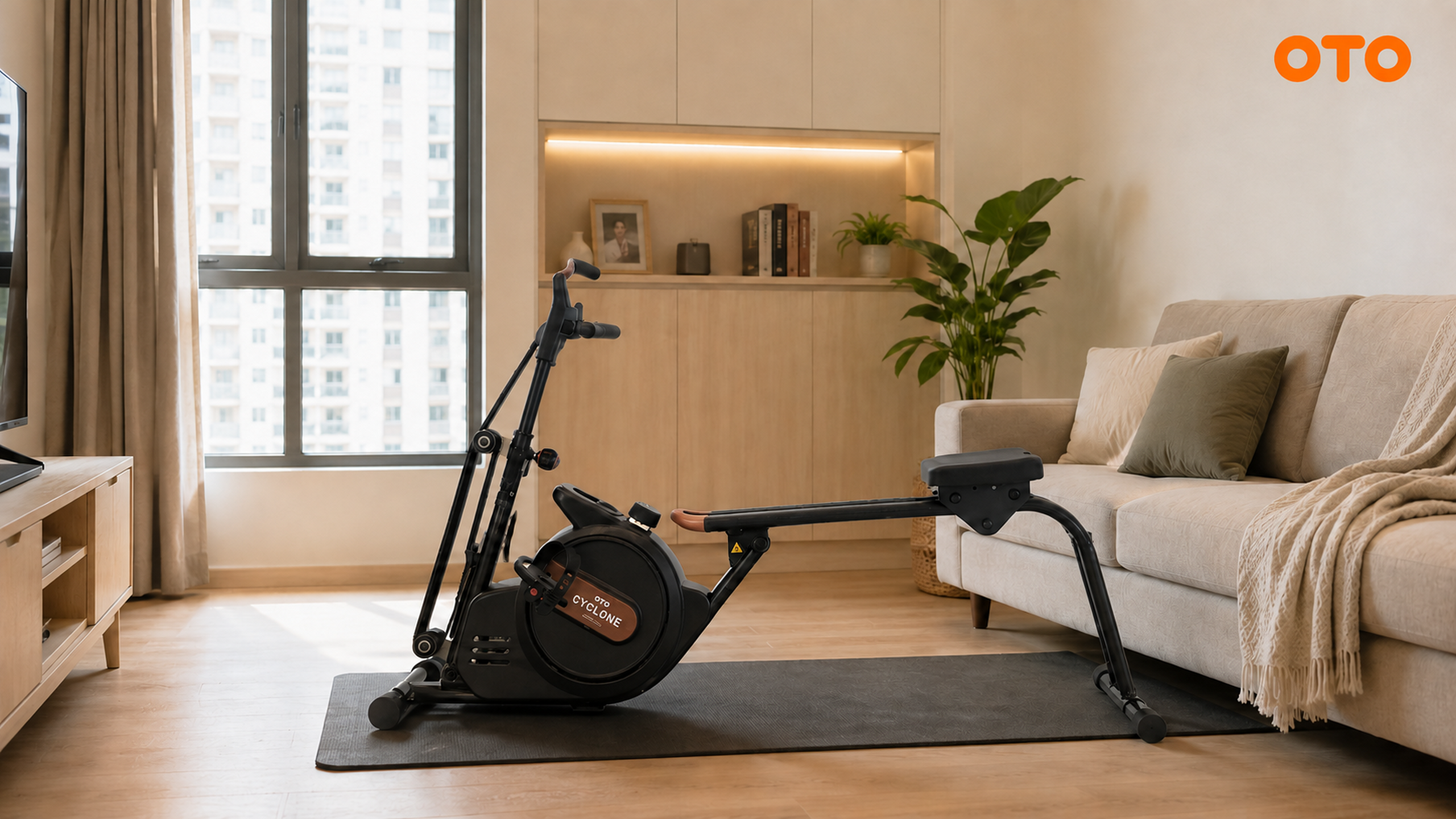
- The OTO Cyclone combines cycling, rowing, pulling, lifting and core exercises in one foldable machine, making it the most versatile all-in-one option on this list.
- Resistance bands, adjustable dumbbells and mobility accessories can expand your workout options without taking over the room.
- Before buying, measure your available space and consider noise, floor protection, setup time and the needs of everyone who will use the equipment.
Building a home gym in Singapore can feel like a game of Tetris. You want enough equipment for a useful workout, but you still need room to walk, work and live when the session is over.
The best compact home exercise equipment is not simply the smallest option available. It should make good use of limited floor space, support the workouts you actually enjoy, operate without excessive noise and store away with minimal effort. A versatile machine or a few carefully chosen accessories will usually serve you better than a room full of single-purpose equipment.
Singapore’s physical activity guidelines recommend that adults aim for 150 to 300 minutes of moderate-intensity aerobic activity each week, together with muscle-strengthening activities on at least two days. A practical home setup can make those targets easier to work towards, especially when travel time, unpredictable weather or a busy schedule gets in the way.
Below are seven compact options for different goals, budgets and home layouts, including an all-in-one machine for households that want more workout variety from a single footprint.
Compact Home Exercise Equipment at a Glance
| Equipment | Best for | Storage advantage | Main consideration |
|---|---|---|---|
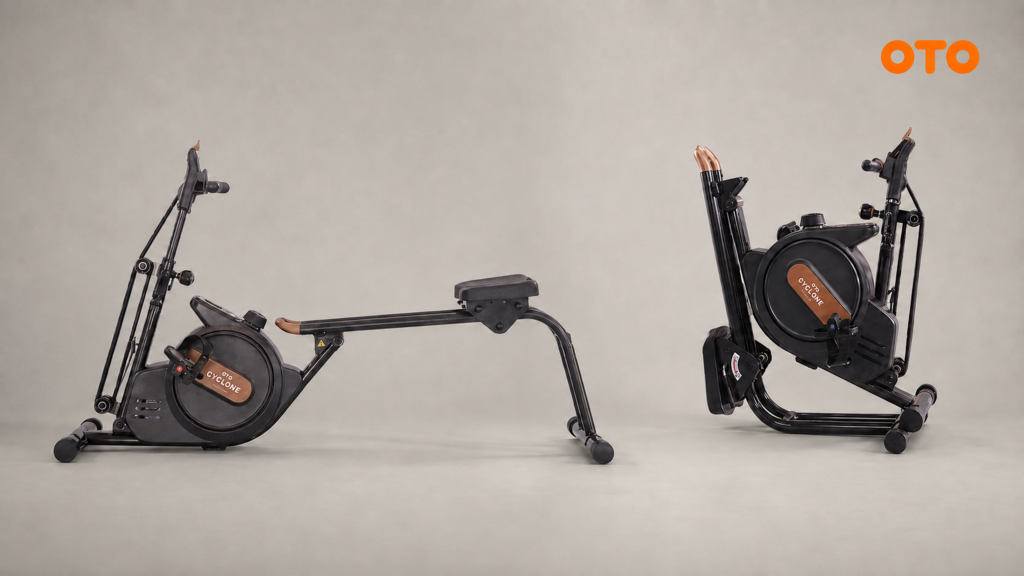
| OTO Cyclone | All-in-one cardio and strength training | Folds to 80 × 50 × 90 cm and moves on castor wheels | Requires 160 cm of clear length when fully expanded |
| Resistance bands | Budget-friendly strength and mobility | Fits inside a drawer or small bag | Resistance feels different from free weights and bands should be checked for wear |
| Adjustable dumbbells | Progressive strength training | Replaces several pairs of fixed dumbbells | Needs careful handling and floor protection |
| Foldable walking pad | Indoor walking and light cardio | Many models can slide under suitable furniture | Check stored height, noise, weight limit and available walking space |
| Yoga mat, sliders and foam roller | Mobility, core work and recovery | Rolls up or stores vertically | Requires enough clear floor space to move comfortably |
| Compact stepper | Short cardio sessions | Small footprint and easy to move | Offers less movement variety than larger machines |
| Skipping rope | Low-cost, high-intensity cardio | Fits almost anywhere | Impact, ceiling clearance and noise may not suit every home |
1. OTO Cyclone: Best All-in-One Compact Exercise Machine
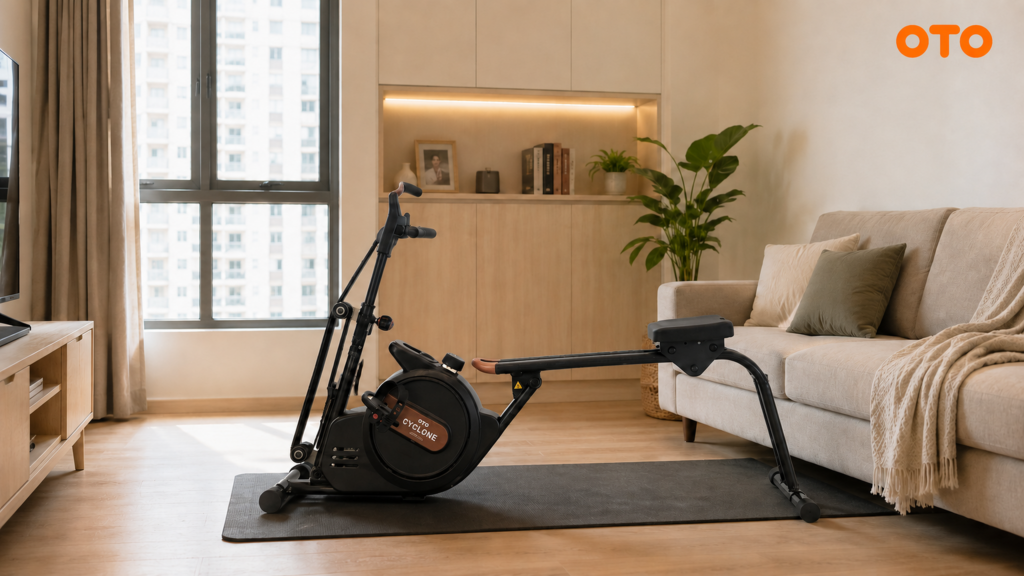
If you want the variety of a larger home gym without buying several separate machines, the OTO Cyclone CN-1000 is the strongest all-in-one option.
The Cyclone combines cycling, rowing, pulling, lifting and sit-up exercises in one machine. This allows you to alternate between cardio, endurance and resistance-based movements without giving up space to a separate exercise bike, rowing machine and strength station.
Why It Suits Singapore Homes
The machine measures 160 × 50 × 90 to 110 cm when expanded. After use, its length collapses to 80 cm, giving it a stored size of 80 × 50 × 90 cm. In practical terms, folding it reduces its floor footprint from approximately 0.8 m² to 0.4 m².
Front and rear castor wheels help you reposition it on a level floor, while its belt-driven cycling system and magnetic flywheel are designed for quieter indoor workouts. That makes it a more neighbour-conscious option than repeated jumping or other high-impact cardio, although a suitable equipment mat is still recommended to reduce vibration and protect the floor.
Other useful features include:
- Eight levels of magnetic resistance for easier progression
- A tension rope with up to 20 kg of tension force
- Seven handle-post height settings and three angle settings
- A monitor that displays time, estimated calories, distance and speed
- A device holder for following workouts or watching content
- Support for users up to 120 kg and 1.9 m tall
At 32.5 kg, the Cyclone is better described as movable rather than portable. Plan to roll it between nearby positions instead of carrying it from room to room.
Best for: Households that want varied full-body training from one space-saving machine.
Consider before buying: Mark out the full 160 × 50 cm in-use footprint and leave additional clearance around the machine for safe movement.
2. Resistance Bands: Best for Small Budgets and Smaller Spaces
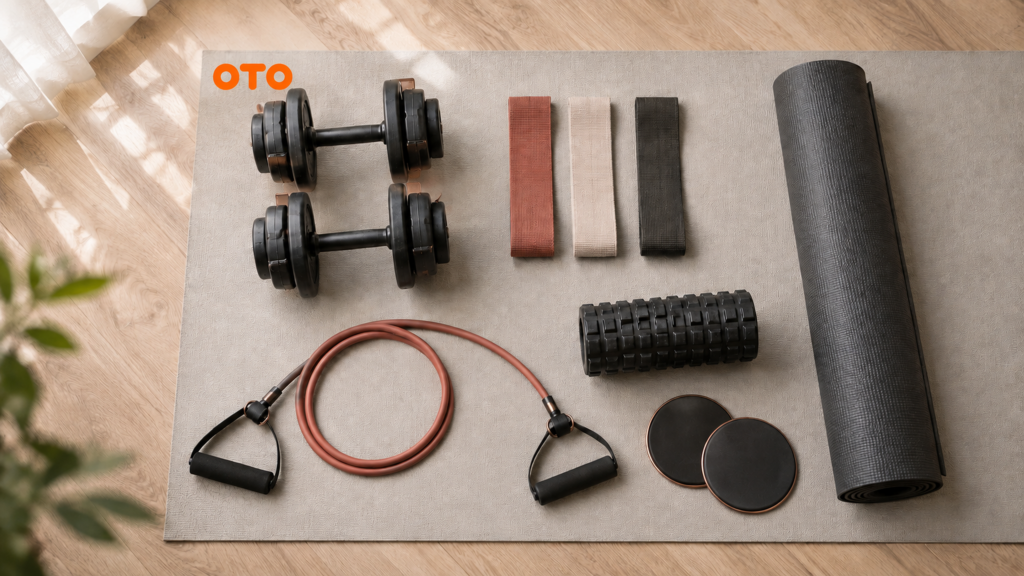
Resistance bands are among the easiest home fitness tools to store. A set of loop bands and longer handled bands can support exercises such as rows, presses, squats, lateral walks and assisted stretches, then disappear into a drawer when you are done.
They are particularly useful for beginners, frequent travellers and anyone who wants to add resistance work without keeping weights at home. Different band strengths also make it possible to increase difficulty gradually.
Bands do not provide the same feel or loading pattern as dumbbells or a cable machine, and they can degrade over time. Inspect them regularly for cracks, thinning or damage, and secure them only to a stable anchor designed for the purpose.
Best for: Portable strength, warm-ups and mobility work.
Consider before buying: Choose a set with clearly labelled resistance levels and suitable handles or anchors.
3. Adjustable Dumbbells: Best for Progressive Strength Training
Adjustable dumbbells replace several pairs of fixed weights with one compact set. They are useful for presses, rows, squats, lunges, carries and other strength exercises, making them a strong choice when building muscle is the main goal.
Selector-style models are fast to adjust, while plate-loaded handles are usually simpler and may cost less. Whichever design you choose, check the available weight range and whether the adjustment increments are small enough for exercises involving weaker muscle groups.
A compact storage stand can keep the weights organised and reduce bending. Place the set on dense rubber flooring or a protective mat, and avoid dropping adjustable mechanisms, which can damage both the equipment and your floor.
Best for: People who want measurable strength progression without a full dumbbell rack.
Consider before buying: Account for the space needed to perform each exercise, not just the dimensions of the weights.
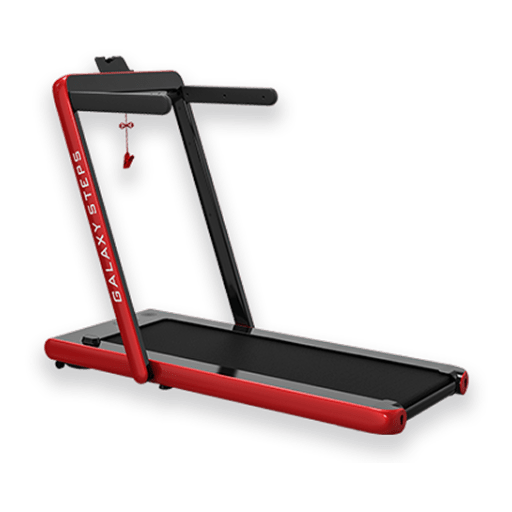
4. Foldable Walking Pad: Best for Increasing Daily Movement
A walking pad can help you add indoor steps while watching television, listening to a podcast or working at a suitable standing desk. It can be especially useful during wet weather or on days when leaving home for a longer walk is inconvenient.
Some models fold or store flat under a bed, sofa or raised cabinet. However, “slim” does not automatically mean it will fit your furniture. Measure the unit’s folded length, width and height, as well as the actual clearance beneath the intended storage area.
Walking pads are designed mainly for walking or light jogging, depending on the model. Check the maximum speed, user weight limit, belt dimensions, warranty and noise level before deciding. A treadmill mat can help protect vinyl, tile or timber flooring and reduce transmitted vibration.
Best for: Low-barrier daily cardio and step goals.
Consider before buying: A shorter or narrower belt saves space but may feel restrictive, particularly for taller users or faster walking speeds.
5. Yoga Mat, Exercise Sliders and Foam Roller: Best Compact Mobility Kit
A good exercise mat creates a dedicated surface for mobility drills, stretching, bodyweight strength and core work. Add a pair of sliders and you can perform movements such as mountain climbers, hamstring curls, plank variations and sliding lunges without adding much storage bulk.
A foam roller can support a simple post-workout mobility routine and stores easily in a wardrobe or upright beside the mat. If space is especially tight, choose a shorter roller after checking that it still suits the areas you intend to use it on.
For Singapore’s humid climate, look for a mat with a non-slip surface that is easy to wipe down. Let it dry fully before rolling it up to prevent trapped moisture and odours.
Best for: Mobility, core training, stretching and bodyweight sessions.
Consider before buying: Make sure you can clear enough floor space to extend your arms and legs without hitting furniture.
6. Compact Stepper: Best for Short Cardio Sessions
A mini stepper provides a repetitive climbing motion from a footprint that is usually much smaller than a treadmill or exercise bike. It can work well for short sessions when you want to raise your heart rate without setting up a larger machine.
Some models include resistance cords for upper-body movement, although the main training stimulus remains lower-body stepping. Hydraulic resistance can become warm during extended use, so follow the manufacturer’s session limits and maintenance instructions.
Look for wide, textured pedals, a stable base and a weight rating that suits every intended user. A small mat underneath can improve grip and protect the floor.
Best for: Quick cardio sessions in a small exercise corner.
Consider before buying: The fixed movement pattern offers less variety than a multifunction machine and may not suit everyone’s knees, hips or balance.
7. Skipping Rope: Best for Maximum Cardio in Minimum Storage Space
Few pieces of exercise equipment are as easy to store as a skipping rope. It can support short interval sessions, coordination drills and warm-ups without taking over a cupboard.
The catch is that the workout needs more usable space than the rope itself. Check your ceiling height, overhead lights, fans and nearby furniture before starting. Repeated landing can also create noise and vibration, which may be unsuitable for some apartments or late-night sessions.
If indoor skipping is not practical, a rope-less weighted design can reduce the clearance required, although it does not perfectly reproduce the timing and feedback of a traditional rope.
Best for: Efficient cardio when storage is the main constraint.
Consider before buying: Use supportive footwear and an appropriate surface, and be considerate of neighbours below.
How to Choose the Right Equipment for Your Home
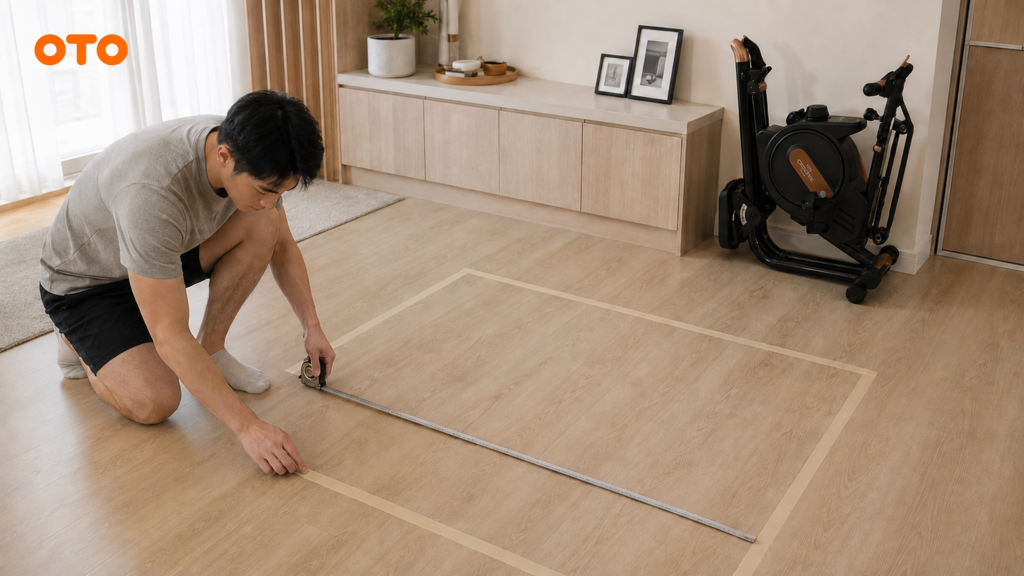
1. Measure Twice: Storage Space and Workout Space
Manufacturers often highlight folded dimensions, but you also need the full working footprint. Use masking tape to mark the equipment’s dimensions on your floor. Then simulate the movements you will perform and check that doors, walkways and furniture remain clear.
2. Start With Your Main Fitness Goal
- For one versatile machine, consider the OTO Cyclone.
- For progressive strength, choose adjustable dumbbells or resistance bands.
- For more daily walking, consider a foldable walking pad.
- For mobility and core work, start with a mat, sliders and a foam roller.
- For short cardio sessions, consider a stepper or skipping rope if impact and noise are not concerns.
3. Be Realistic About Noise
Magnetic resistance, low-noise rollers and controlled movements are generally more apartment-friendly than running or jumping. Even so, floor construction, equipment stability and workout technique affect how much sound travels. Use a dense equipment mat where appropriate and avoid placing moving equipment directly against a shared wall.
4. Reduce Setup Friction
The best equipment is the equipment you will use. If every workout requires moving several boxes and rearranging half the living room, motivation will eventually lose that argument. Favour equipment that unfolds, adjusts and stores in a few simple steps.
5. Check User Fit and Safety Limits
Review the maximum user weight, supported height range, handle and seat adjustments, pedal or belt dimensions and recommended clearances. If several people will share the equipment, make sure it can be adjusted comfortably for the tallest, shortest and heaviest intended users.
A Practical Compact Home Gym Setup
You do not need all seven items. For most homes, a simple three-part setup is enough:
- One anchor for cardio and full-body work: A multifunction machine such as the OTO Cyclone.
- One compact strength accessory: Resistance bands or adjustable dumbbells, depending on your experience and goals.
- One clear floor surface: A mat for warm-ups, mobility, core exercises and cooldowns.
This combination covers more training needs than collecting multiple cardio machines, while keeping storage manageable.
Frequently Asked Questions
What Is the Best Compact Home Exercise Equipment for an HDB Flat?
The best choice depends on your available floor space and preferred workout. Resistance bands are the smallest option, adjustable dumbbells are effective for strength training, and a walking pad suits indoor walking. If you want both cardio and resistance-based movements from one machine, a foldable multifunction trainer such as the OTO Cyclone is a more versatile choice.
How Much Space Does the OTO Cyclone Need?
The OTO Cyclone measures 160 × 50 × 90 to 110 cm when expanded and 80 × 50 × 90 cm when folded. You should also leave clear space around it so you can mount, dismount and move through each exercise safely.
Is Magnetic Resistance Suitable for Apartment Workouts?
Magnetic resistance is commonly chosen for indoor equipment because it allows smooth resistance adjustment without the repeated impact of jumping or running. Overall noise will still depend on the machine, floor, maintenance and how it is used.
Can Compact Home Equipment Replace a Gym Membership?
For general cardio, strength and mobility goals, a well-planned home setup can provide plenty of training variety. A commercial gym may still be preferable if you need very heavy weights, specialised machines, classes or coaching. The better choice is the one you can use consistently.
How Often Should I Exercise at Home?
Singapore’s physical activity guidelines recommend 150 to 300 minutes of moderate-intensity aerobic activity and muscle-strengthening activity on at least two days each week. Beginners can start with shorter, manageable sessions and build up gradually.
Make Every Square Metre Work Harder
A compact home gym should fit your life, not force your home to revolve around exercise equipment. Start with the activity you are most likely to do consistently, measure your space carefully and choose products that can support more than one stage of your fitness journey.
For households that want cardio and strength-focused movements without buying several machines, the OTO Cyclone CN-1000 brings cycling, rowing, pulling, lifting and core training into one foldable design. Explore the Cyclone’s full specifications and see whether it fits your home workout space.





 Login with Google